SQL
语法
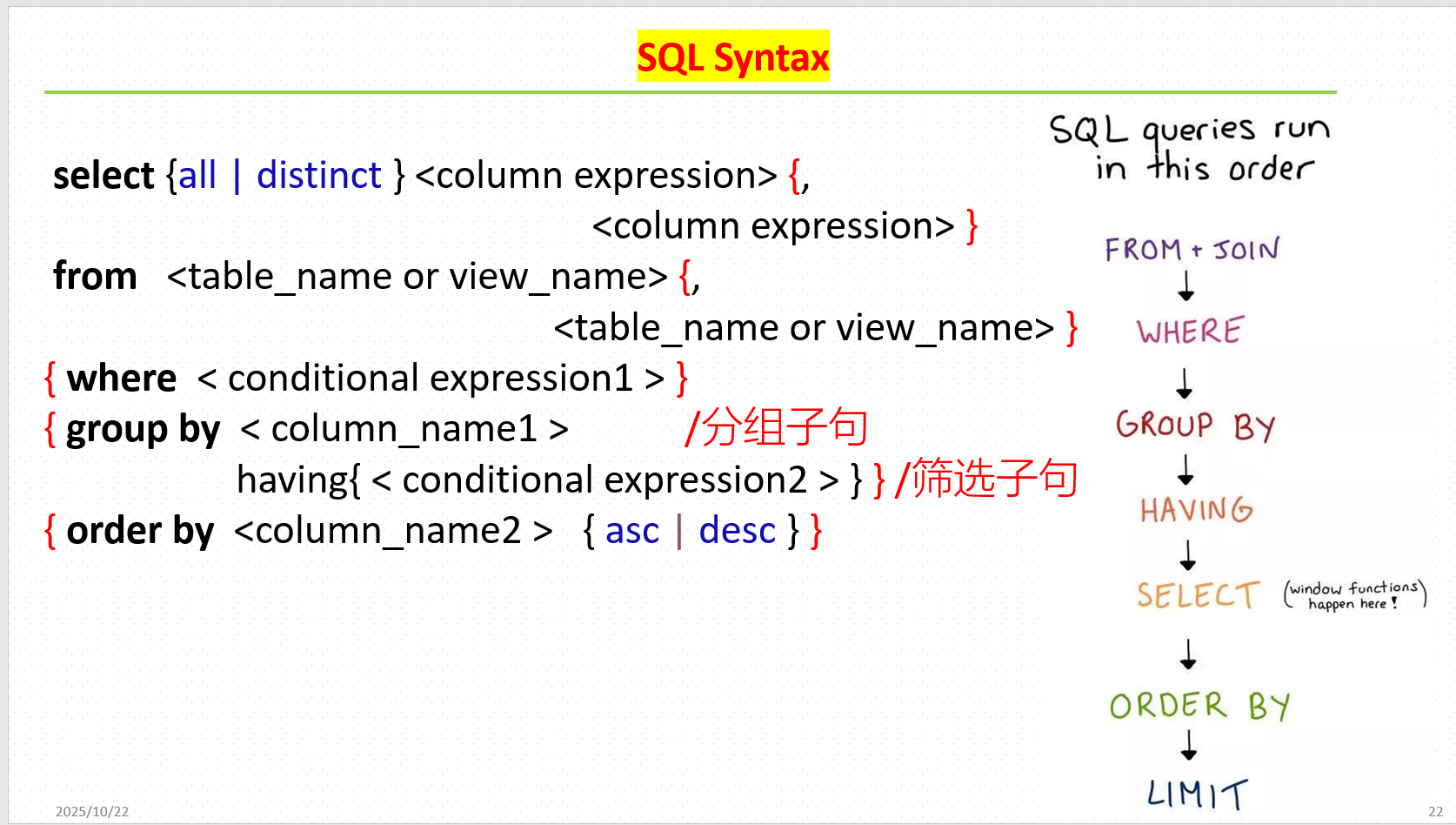
SELECT
distinct 去重
1
2
|
select `distinct/all` dept_name
from instructor
|
四则运算和重命名
1
|
select ID, name, salary/12 as monthly_salary
|
FROM
natural join 自然连接
1
2
3
4
|
select name, course_id
from instructor natural join teaches
where instructor. dept_name = ‘Art’
// 等价于加上 where instructor.ID = teaches.ID and
|
WHERE
SQL allows the use of the logical connectives and, or, and not
The operands of the logical connectives can be expressions involving the comparison operators <, <=, >, >=, =, and <>.(以及between A and B 用法)
Tuple comparison
1
2
3
|
select name, course_id
from instructor, teaches
where (instructor.ID, dept_name) = (teaches.ID, 'Biology');
|
Tuple Variables
涉及到对instructor关系中属性salary的不同值的比较
1
2
3
|
select distinct T.name
from instructor as T, instructor as S
where T.salary > S.salary and S.dept_name = ‘Comp. Sci.’
|
执行顺序
FROM - 从表中获取数据
WHERE - 对原始行数据进行筛选
GROUP BY - 对筛选后的数据进行分组
HAVING - 对分组后的聚合结果进行筛选
SELECT - 选择要显示的列
在 WHERE 子句中不能直接使用 COUNT 等聚合函数,因为执行顺序的问题。
1
2
3
4
5
|
-- ✅ 正确:使用HAVING对分组结果进行筛选
SELECT department, COUNT(*) as emp_count
FROM employees
GROUP BY department
HAVING COUNT(*) > 5;  -- 这里COUNT()在每组内计算
|
CTE
 1
 2
 3
 4
 5
 6
 7
 8
 9
10
11
12
13
14
15
16
17
18
19
20
21
22
23
24
25
|
WITH
department_stats AS (
    SELECT
        department,
        AVG(salary) as avg_salary,
        COUNT(*) as employee_count
    FROM employees
    GROUP BY department
),
high_avg_departments AS (
    -- 这个CTE引用了前一个CTE
    SELECT
        department,
        avg_salary
    FROM department_stats
    WHERE avg_salary > 6000
)
-- 主查询
SELECT
    e.name,
    e.salary,
    h.avg_salary as department_avg
FROM employees e
JOIN high_avg_departments h ON e.department = h.department
WHERE e.salary > h.avg_salary;
|
GROUP BY
Attributes in select clause outside of aggregate functions must appear in group by list(必须要有聚合运算)
错误示例:
1
2
3
4
|
/* erroneous query */
select dept_name, ID, avg (salary) -- ID 不在聚合属性中
from instructor
group by dept_name
|
正确用法:(可以有多个聚合运算)
| product |
category |
sales_amount |
| A |
Electronics |
100 |
| B |
Electronics |
150 |
| A |
Electronics |
200 |
| C |
Clothing |
80 |
| B |
Electronics |
120 |
1
2
3
4
5
6
|
SELECT
    category,
    COUNT(*) as transaction_count,
    SUM(sales_amount) as total_sales
FROM sales
GROUP BY category;
|
| category |
transaction_count |
total_sales |
| Electronics |
4 |
570 |
| Clothing |
1 |
80 |
常用聚合函数
1
2
3
4
5
6
7
8
9
|
SELECT
    department,
    COUNT(*) as employee_count,      -- 计数
    AVG(salary) as avg_salary,       -- 平均值
    SUM(salary) as total_salary,     -- 求和
    MAX(salary) as max_salary,       -- 最大值
    MIN(salary) as min_salary        -- 最小值
FROM employees
GROUP BY department;
|
ORDER BY
1
2
|
SELECT * FROM employees ORDER BY salary DESC;
SELECT * FROM employees ORDER BY department ASC, salary DESC;
|